
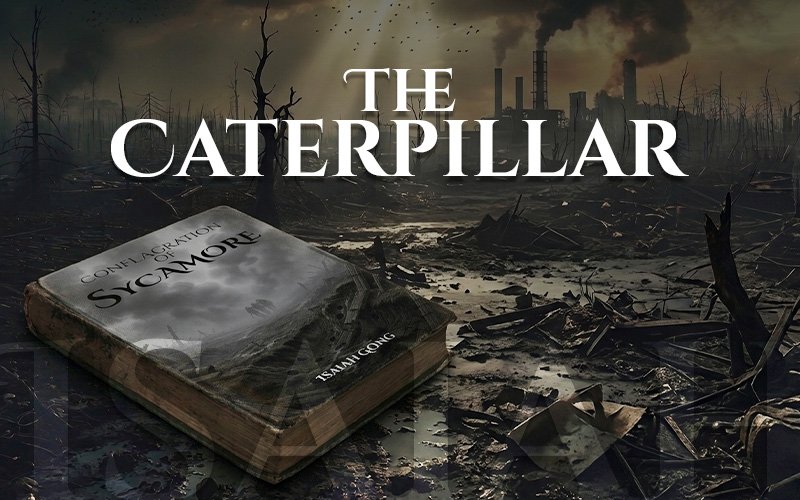
It was a cold winter morning. The sun hid behind heavy gray clouds, and ice hung off the branches and glistened on the sides of the boulders. Despite the trail being cleared yesterday, an additional foot of snow covered it overnight, guaranteeing an arduous trip to the ruins.
As our horse trudged down the trail, I peeled my eyes from the forest and stared intently at my father, who gripped the reins tightly and held an unreadable expression. I knew better than to start a conversation with him. A stoic general, Father kept to himself and only spoke when necessary.
I burrowed my hand into my coat pocket to feel the soft toy caterpillar I constructed when I was small. Made of interwoven balls of yarn, the caterpillar was the only source of comfort I had in my austere life, in which I had to wake up at six in the morning every day, fold my coarse blankets over the firm mattress, and carry out my morning chores that were primarily outdoors since the house was empty save for the necessities.
In thirty minutes, we met the tree line. As we crossed the threshold into the ruins, the chill of a peaceful winter morning shifted into the coldness of a mausoleum, hitting me with a different sort of numbness that weighed down on the soul.
Father steered the horse onto the central avenue of the deserted city. The wind was nonexistent, as though it willfully avoided this area. Around us was complete silence. It seemed as though the trees along the forest’s perimeter grew at an angle away from the ruins, repulsed by the death the air bore.
As we neared the center of the city, I gazed at the sights: a raised, marble platform in the middle of a dried-up pool, a stone pavilion with a fire pit, a seating area with cracked stone benches, and a park with a few dark shrubs. Carcasses that were once stately buildings stood mournfully to our sides. Some of them were intact with a few broken windows. Others had large gaping holes, groaning and swaying in the wind. Still, some could barely be considered buildings, only a foundation with a few wooden posts jutting out.
Father stopped the horse in the center of the ruins in front of a circular fountain with a ghostly statue of a robed person in the middle. The statue was atop a pedestal and was missing its upper half. Once a lusterous, pearly white, the statue was now a repulsive shade of muddy green and dark gray.
I soon found myself hauling fine silk rugs out from the trailer and rolling them out on the snow. Out came hand-carved maple chairs gifted by governors from the West, lavish furniture, antique lockets, and precious porcelain vases coated in shiny blue glazes.
Into the growing pile of luxuries came glassy white ceramic cups with gold rims, jewelry made with precious gems, leather wineskins, lush and soft fabrics from the Far East, fur coats, silverware, spotless mirrors, and deep-blue cobalt glassware. The pile continued to grow taller until it was chest high. At last, I placed the last item from the trailer, a wooden jewelry box, on the top of the pile.
Father was taught to accept gifts graciously as an act of diplomacy, but he never kept them for his own purposes. Rather, he would store the gifts in a locked room in the cellar.
Despite Father’s pleas, people continued to give him expensive presents after successful military campaigns. Father could never escape the lords, businessmen, rich merchants, and wealthy landowners swooning with praise for his heroism. Little did they know that their gifts did more harm than good.
To Father, wearing a silver ring would be the equivalent of hauling a boulder up a mountain. I took a few steps back and watched as Father lowered a torch on the carpets. The pungent smell of burning entered my nostrils as heat radiated through the atmosphere.
I felt no warmth as I stared into the fire, which licked the antique tables and chairs, consumed the porcelain dishes, and reduced the expensive fabrics to dust. All these coveted luxuries were worthless now: engulfed in flames, reduced to atoms, and forgotten.
Father’s shoulders relaxed, though the look of melancholy I’ve grown used to still hung on his face. With the burden off his back, Father looked weary with a year’s worth of hiding pain. Our pilgrimage was the only time he could show weakness.
“Let me tell you about this city,” Father spoke for the first time.
My ears perked up, surprised to hear Father’s husky voice.
“When I was your age, I joined the war effort and was stationed in this city. They called it the City of Dreams since everyone dreamed of being wealthy enough to live here. The buildings were tall, the roads glistened under the sun like gold, and the wells here contained the cleanest water in the Empire. No one could imagine that war would touch them.”
Father paused, gathering his thoughts, as I stared intently at him.
“I was youthful. I wanted to see action. I wanted adventure. I should have been more careful in what I wished for,” Father continued. “The Irkhet forces surrounded the city and besieged it right before the coldest and longest winter ever recorded in history.
“In two months, the city ran low on food. Riots broke out, and I was forced to control starving and voracious mobs from tearing each other apart. In five months, every crow was shot down, and every rat was eaten. We had to monitor the houses and apartment buildings to make sure the residents were breathing. House after house, I distributed minuscule rations to starving families. They had giant oil paintings, expensive silverware, and the finest furniture, but without food to survive.”
Father lowered his head into his hands.
“The Irkhet forces advanced into the city after seven months into the siege. I do not know how I survived. I was … lucky. It does not make any sense.”
Father turned to face away from me to conceal the emotions puddling up in the corner of his eyes.
“All these gifts we receive are worthless. I hate them. They can not save our lives. We can not be attached to them. They must be burned and forgotten,” Father said firmly.
Whatever warmth left in my body vanished as the pieces clicked together. Our neat and unfurnished home, the somber undertone hiding behind Father’s fierce eyes, and frequent winter pilgrimage all pointed to a man battling grief, not a man torn on discipline for the sake of routine.
Once again, I dug my hand into my pocket to seek the comfort of the caterpillar. This time, I did not feel its warmth.
My attention shifted to the ruined city. I imagined performers standing by the firepit in the stone pavilion, reciting fables of ancient times and engrossing people in the stories of kings who fought bloodless battles.
I saw elderly men sitting in the park, talking about the good old days, scolding the younger generations, playing cards, or discussing their favorite books. I saw the ghosts of merchants entering the city gates and bargaining over prices. I saw women lining up to fill pitchers of water from the numerous wells. I saw kids stealing confectionery from the various shops as they were chased out by workers.
My eyes darted back to the statue in front of us. Despite its upper half missing, I could imagine the power the statue once held as it pompously stood adorned on its pedestal in the center of the city and gazed at the life below.
Once admired by the crowds around it, the war left the statue eternally scarred and alone. The statue was forgotten, bereft of its original luster and stateliness. All it could do now was age and live among ghosts.
Just like Father, half of the statue was lost in the past–a brighter past.
I approached the fire and took the toy caterpillar out of my pocket. Outstretching my hand, I dropped the toy into the flames and watched it burn as the smoke billowed up into the gray sky.